In the Doghouse

Featured

Breaking my leg in Spain last year has changed my life. Traumatized and still recovering 9 months later, I need to spend quality time with my closest family, all of them on the other coast near Boston. Not the kind of trip where I’m there for a week staying with one of them, feeling in the way and ill at ease. It’s time for an extended trip, with my own place to sleep. I’ll be able to cook for myself, see family and explore the area at my own pace. A month in Boston! 

The last time I was away from home for this long, I took Chewy and drove to Montana. The drive was harrowing with a dog who hates the car. Nevertheless, I want to take him with me again. Driving is not an option, so I booked non-stop flights for the two of us from San Francisco to Boston and back. I’ll be in an aisle seat and he’ll be underneath in a soft carrier.

Seven years ago, I brought Chewy home from the shelter. He was 3 and not crate trained. The first week I bought a soft carrier. I didn’t want to leave him at home alone, but he sure didn’t want to go into the box. My unfortunate technique was to force him in and zip it up quickly. On one of our first outings, I took him to the church, where I had a meeting to attend. I set down the crate and left the room. In less than 5 minutes, he had managed to get out of it and was running around the building. Flying with Chewy is going to take training.

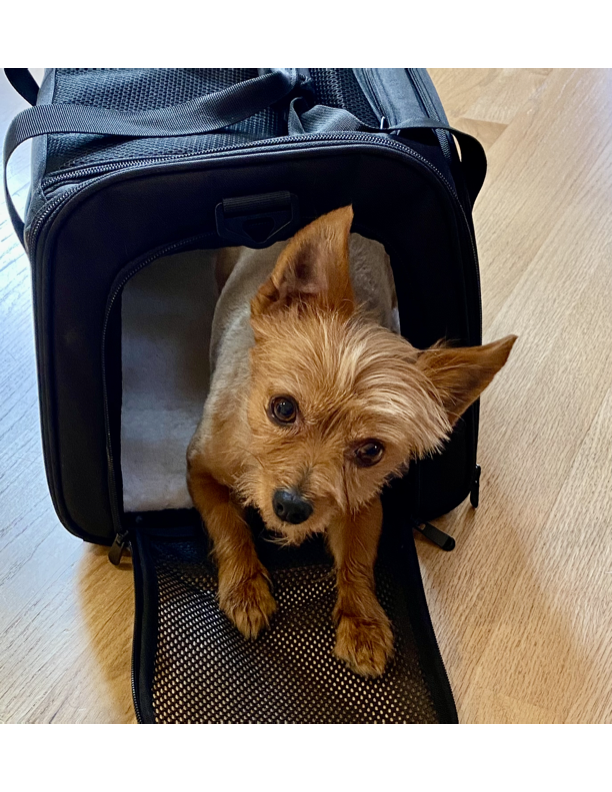
A friend gave me a new soft crate, the exact size the airline allows. There’s plenty of room for Chewy to stand and turn around. But how to coax him inside? I tried throwing treats in, but he would only go after them when I was far enough away that he could grab the treat and get out before I could lock him inside. 

So I called a trainer. One session was all I needed. Her biggest contribution was bringing a bag of treats that are irresistible to Chewy. He will do anything for those treats. For many days, I practiced throwing in the treat, and praising him for going after it, with the door to the crate remaining open.  

Chewy has learned to go into the crate on demand and wait for the tasty bits. He can be zipped up for 5 or 10 minutes before he begins to growl or whine. Actually, he’ll stay as long as the treats keep coming, but that won’t work for a 5-hour plane ride with no chance to go potty. 

There will be drugs. I haven’t experimented yet, but the vet advised sedating him when I first put him in the crate for the ride to the airport. If his sleepiness wears off before we get to Boston, I can give him another dose. Poor guy. I hope he’ll find it a reasonable trade, in order to spend the month with me and my extended family. It will mean a lot to me to have a bark alarm at night in my rental house, and to enjoy my daily Chewy walks and cuddles. 
LEARNING TO WALK, PART TWO

It’s fascinating how our lives meld with those of our housemates, including pets. Here it’s just Chewy and me. I’ve written about the challenges of Covid and needing to re-institute training to improve our daily walks. That is, reteaching myself to use the right commands and pay attention to what Chewy is doing. 2023 has presented a new challenge for our life together and for our walks. 

In April, I left Chewy with our wonderful dog sitter, Cheri, while I traveled to Spain. Unfortunately, I didn’t return after the planned 12 days. I broke my femur in a silly accident and spent two weeks in the hospital in Seville. (You can read that horror story at lenorehirsch.com.) Chewy stayed with Cheri for three weeks, longer than I’d ever left him, and when he joined me back at home, I was stuck in a wheelchair. 

Chewy immediately adapted his behavior to match mine. Those first nights, he let me lift him onto the bed and he snuggled with me for the whole night. No trips out into the yard through the doggie door in the middle of the night to bark at something, requiring me to go outside to retrieve him. I wouldn’t have been able to get down the steps to do that. 

He had no play time in those first weeks. Tossing a ball was the last thing on my mind. 

When he’s with Cheri, he has plenty of play time, but no walks, so he didn’t seem to miss those at first. Occasionally, a visiting friend would try to take him out. They’d get ten feet from the front door and Chewy would stall, refusing to go further. He just didn’t want to leave me. A determined dog walker would insist, but most folks just brought him back. I managed to feed him a couple of times a day, but he has never been a great eater. 

For weeks, it was a slow and perhaps depressing time for little Chewy. But he was there by my side and I appreciated the comfort he offered. I rarely left the house, so he had my attention more than usual. During the many hours when I sat on the couch with my legs up, watching TV, he would jump up, nestle in my lap, and rest his upper body on the exact spot where my broken leg had been repaired. Perhaps it exuded heat from the healing process. Perhaps he knew that was where I was broken? This was both comforting and occasionally painful, requiring me to push him off.

Chewy managed to stay out of the way of the wheelchair, and occasionally enjoyed his rides on my lap while I tooled around the house. After six weeks, I transitioned to a walker.  Chewy quickly learned to stay out of the way. The stream of visitors slowed and a dear friend in the neighborhood offered to walk Chewy three mornings a week. She got him to walk by offering treats at the beginning and end of each outing. He started to be more active in the house, occasionally playing with a toy, and eating more. 

By September, I was doing well enough to use a cane. Despite now being a mature adult of 10 years, Chewy can still move fast when the cane crashes to the wood floor from wherever I have left it. As my mobility has improved, he’s returning to his old habits. Going out at 1 a.m. and barking at some critter out there? Check. Growling or barking at 3 a.m. to get up on the bed? Check. Expectantly standing by the treat drawer, even though he hasn’t finished dinner? Check. 

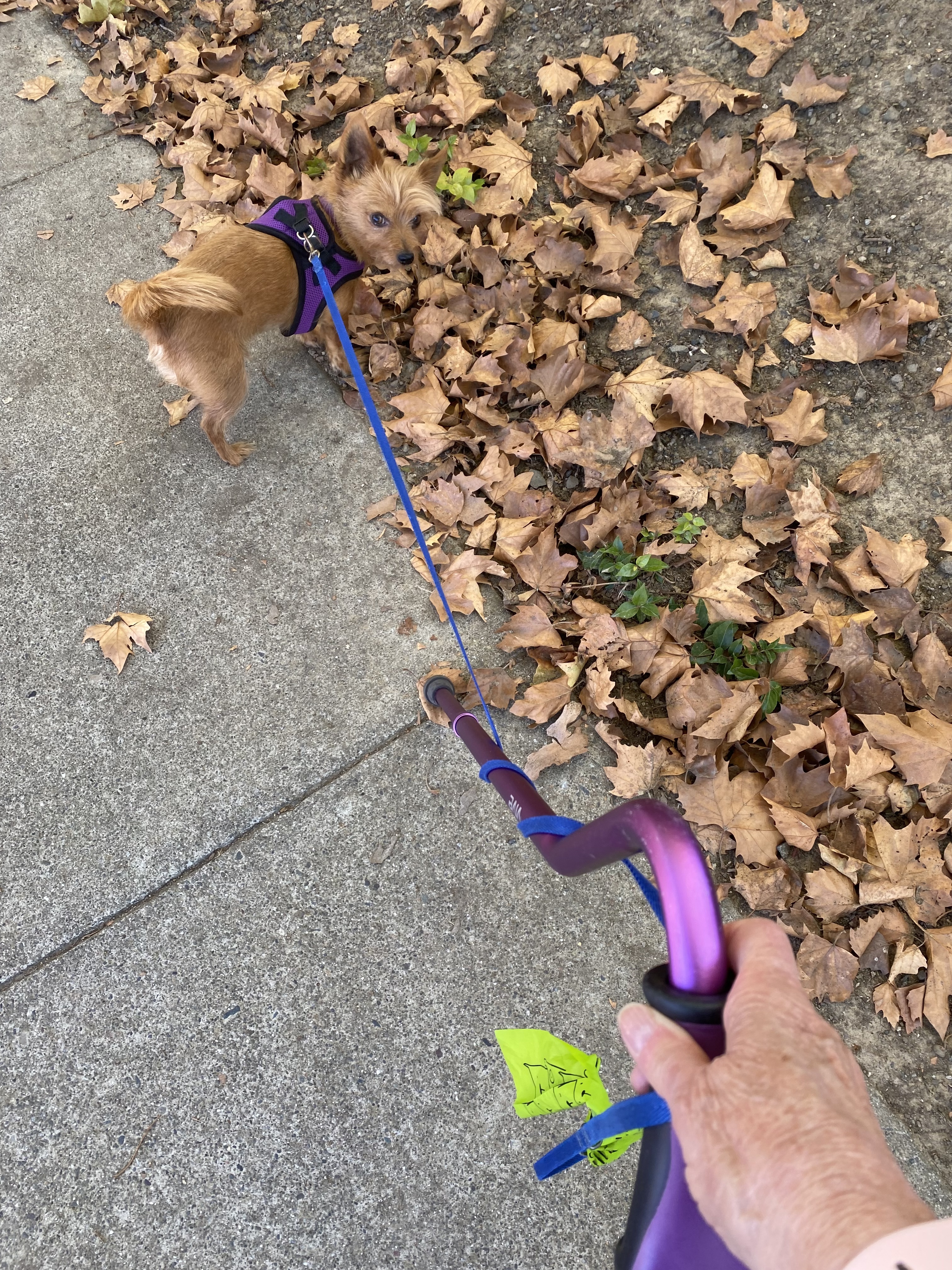
I am now walking Chewy myself, every morning. At first, I was happy to let him sniff every blade of grass. He’d been deprived for so long. The pee-mail had been piling up on every post we passed on our little loop through the neighborhood park. But soon I became impatient with the time our walks took. If I was going to do this every day, it needed to be snappy, or my leg would hurt later on. And, after repeatedly untangling the leash from my cane and tripping a couple of times, I needed to keep Chewy and the leash on my left side. 

So, we’re back to “with me” and “release.” He totally gets it and complies, although I have to keep using the commands every day or he’ll resort to endless sniffing. I now throw the ball in the house for Chewy to chase and have even hobbled through the grass in the park a few times to throw his frisbee and watch him run. I go down the steps to call him back in when he’s outside barking in the middle of the night. I’ve changed his food to something he likes better than the kibble I’ve fed him for years. He seems to have more energy. We both do. It seems we have gone through this period of recovery together. 

Learning to Walk

IMG_2265

I have been to enough dog training classes to know that, if there is a problem, it’s mine–not the dog’s. I’ve had Chewy for almost 4 years now and I recall our early times as pleasant. A rescue, he was needy for attention and I gave it to him. His is a loving little guy, but also demanding in the true terrier fashion. Or . . . have I brought that out in him?

Not long ago I would take Chewy on my three mile power walks. He’d stop once in a while to sniff and mark the grass or a pole, but would get into a groove, and since he’s faster than I am, his presence helped me to keep up a good pace.

During these COVID times, things have changed. I no longer take Chewy on my long walks. On the short walks around the neighborhood, I have grown increasingly irritated with his constant stopping to sniff and pee. I want to enjoy my walks, mind wandering as I listen to birds twittering. I want to look not at the dog, but at blossoming trees. Now Chewy increasingly stops and walks as slow as possible, nose in the grass. Or, catching a sound or whiff of something fascinating, tries to double back the way we came.

“Leave it!” “Chewy, what are you doing?” “Come on!” “Let’s go!” My words are increasingly agitated and I know he can feel the tension pouring off me. I know I could drag his 8 pounds down the sidewalk, but that would be cruel and someone might report me to the Humane Society. I was beginning to feel that he was doing these things to annoy me. Sounds like a cranky mom. Time to go back to doggie school–that is, time for me to get back to training.

I started back with my usual commands, “with me” and “release.” They say it doesn’t matter which commands you use, as long as you are consistent. I hold the leash handle in my right hand and my left gives him just a couple of feet to play with. Whenever I spy his cute little nose moving to the side, drawn by some irresistible scent, I give a quick tug. It’s interesting how training a dog to walk on leash is like using the reins on a horse. I often say “uh-uh” at the same time. He knows what that means.

I am constantly amazed by the dog’s intelligence. He gets it. For a while I was saying too much–praising him when he did it right, adding “go, go, go” in a high-pitched, excited voice, still saying “let’s go.” I finally realized those other vocalizations are confusing. If I praise him while he is walking properly, he thinks it is a “release” and heads right for the nearest tree. So now it is just the two commands. I only praise him when he’s already been released. I give him plenty of release time. I even pick out his favorite trees and bushes on our usual walks. In time, I should be able to decrease the breaks in the walking, as he doesn’t need to check all the spots another dog has marked.

I still yearn for a leisurely stroll with my mind drifting up into the clouds, but I’ll have to take those walks without Chewy.