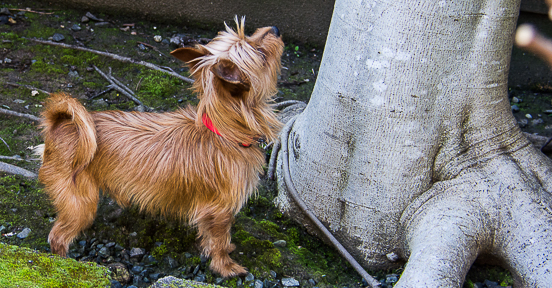
It’s fascinating how our lives meld with those of our housemates, including pets. Here it’s just Chewy and me. I’ve written about the challenges of Covid and needing to re-institute training to improve our daily walks. That is, reteaching myself to use the right commands and pay attention to what Chewy is doing. 2023 has presented a new challenge for our life together and for our walks.
In April, I left Chewy with our wonderful dog sitter, Cheri, while I traveled to Spain. Unfortunately, I didn’t return after the planned 12 days. I broke my femur in a silly accident and spent two weeks in the hospital in Seville. (You can read that horror story at lenorehirsch.com.) Chewy stayed with Cheri for three weeks, longer than I’d ever left him, and when he joined me back at home, I was stuck in a wheelchair.
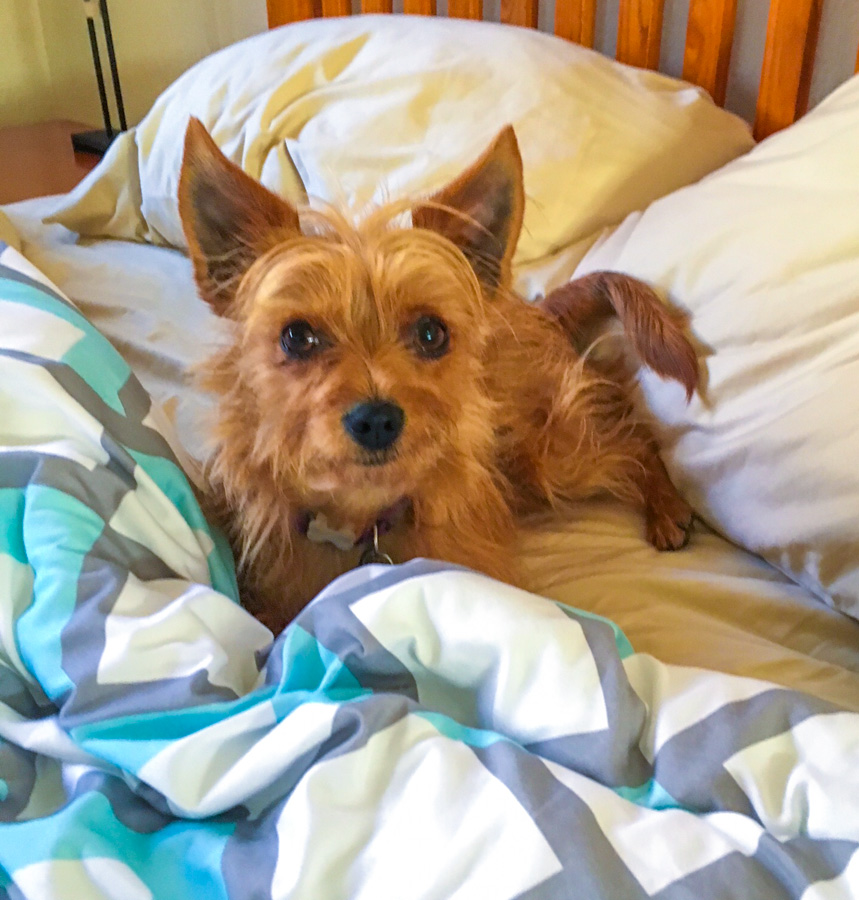
Chewy immediately adapted his behavior to match mine. Those first nights, he let me lift him onto the bed and he snuggled with me for the whole night. No trips out into the yard through the doggie door in the middle of the night to bark at something, requiring me to go outside to retrieve him. I wouldn’t have been able to get down the steps to do that.
He had no play time in those first weeks. Tossing a ball was the last thing on my mind.
When he’s with Cheri, he has plenty of play time, but no walks, so he didn’t seem to miss those at first. Occasionally, a visiting friend would try to take him out. They’d get ten feet from the front door and Chewy would stall, refusing to go further. He just didn’t want to leave me. A determined dog walker would insist, but most folks just brought him back. I managed to feed him a couple of times a day, but he has never been a great eater.
For weeks, it was a slow and perhaps depressing time for little Chewy. But he was there by my side and I appreciated the comfort he offered. I rarely left the house, so he had my attention more than usual. During the many hours when I sat on the couch with my legs up, watching TV, he would jump up, nestle in my lap, and rest his upper body on the exact spot where my broken leg had been repaired. Perhaps it exuded heat from the healing process. Perhaps he knew that was where I was broken? This was both comforting and occasionally painful, requiring me to push him off.
Chewy managed to stay out of the way of the wheelchair, and occasionally enjoyed his rides on my lap while I tooled around the house. After six weeks, I transitioned to a walker. Chewy quickly learned to stay out of the way. The stream of visitors slowed and a dear friend in the neighborhood offered to walk Chewy three mornings a week. She got him to walk by offering treats at the beginning and end of each outing. He started to be more active in the house, occasionally playing with a toy, and eating more.
By September, I was doing well enough to use a cane. Despite now being a mature adult of 10 years, Chewy can still move fast when the cane crashes to the wood floor from wherever I have left it. As my mobility has improved, he’s returning to his old habits. Going out at 1 a.m. and barking at some critter out there? Check. Growling or barking at 3 a.m. to get up on the bed? Check. Expectantly standing by the treat drawer, even though he hasn’t finished dinner? Check.
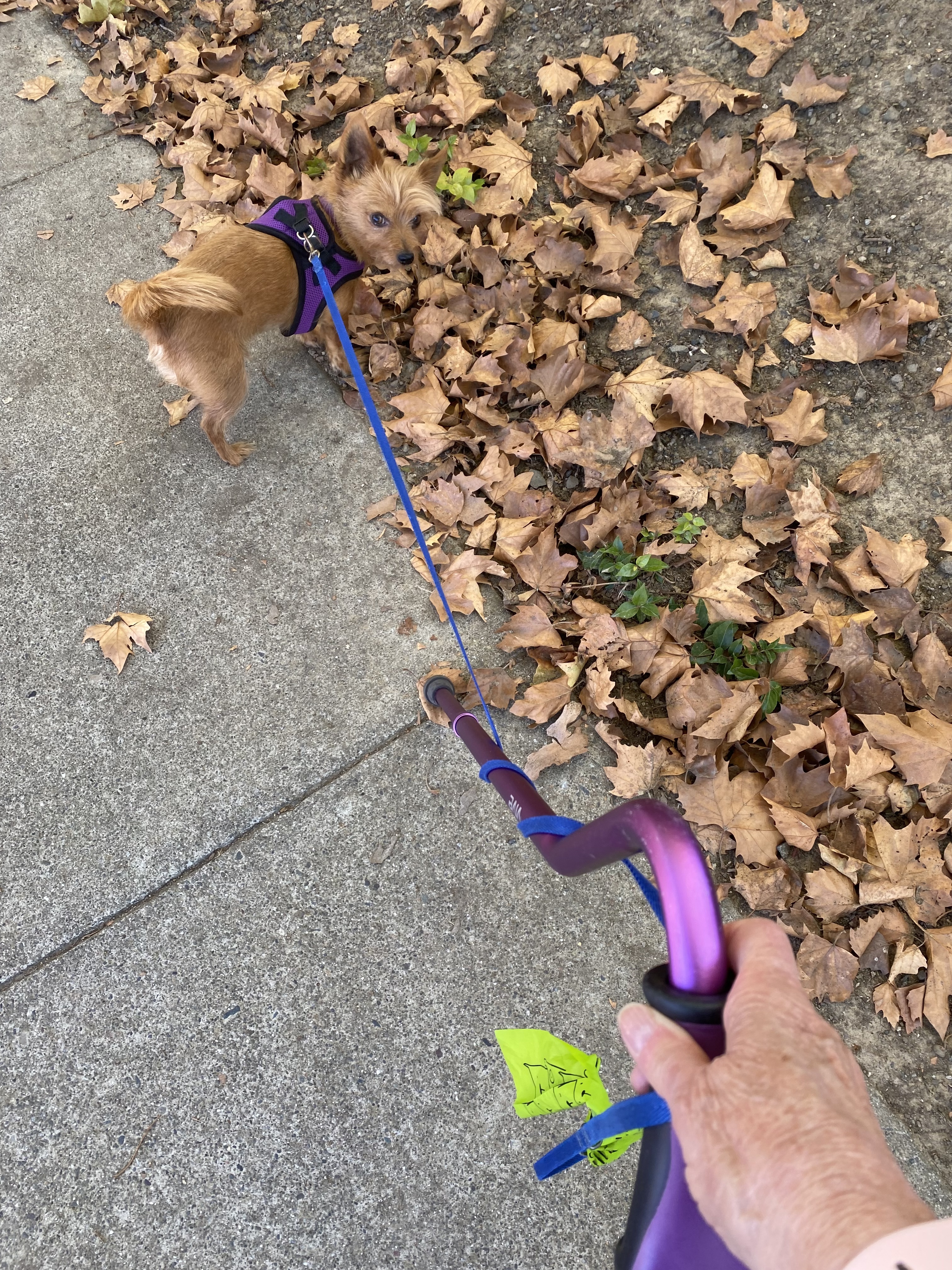
I am now walking Chewy myself, every morning. At first, I was happy to let him sniff every blade of grass. He’d been deprived for so long. The pee-mail had been piling up on every post we passed on our little loop through the neighborhood park. But soon I became impatient with the time our walks took. If I was going to do this every day, it needed to be snappy, or my leg would hurt later on. And, after repeatedly untangling the leash from my cane and tripping a couple of times, I needed to keep Chewy and the leash on my left side.
So, we’re back to “with me” and “release.” He totally gets it and complies, although I have to keep using the commands every day or he’ll resort to endless sniffing. I now throw the ball in the house for Chewy to chase and have even hobbled through the grass in the park a few times to throw his frisbee and watch him run. I go down the steps to call him back in when he’s outside barking in the middle of the night. I’ve changed his food to something he likes better than the kibble I’ve fed him for years. He seems to have more energy. We both do. It seems we have gone through this period of recovery together.

 myleashonlife